


I have a love for words and a knack for SEO – and as a mama, I know just how challenging it can be to run a business while raising a family. This blog is just one of the many resources you’ll find here that’ll help you boost your online visibility without sacrificing your sanity.
Thanks for being here (and I hope you’ll stick around).
Mckayla
categories
blogging
seo
Business
free seo checklist

get your checklist
explore
case studies
to the shop
work with us
follow us on instagram
share

Get access to six simple things you can do in 15-minutes or less to improve your SEO and get your website (and content) to show up in search.
When it comes to finding clients, you’re usually relying on referrals from parents you’ve recently supported through delivery—or posting on socials, crossing your fingers, and hoping it reaches the right audience.
But, as a midwife, what happens when you’re exhausted after a late-night birth and you don’t feel like posting anymore? What if referrals aren’t coming in as often as they used to (or wished they would)?
SEO for midwives (like you) is a tool, or rather, system, that helps you show up when and where your audience is searching—it’s what allows the expectant mothers and parents to find you when they need you, not months after.
And, as an SEO who’s worked with birth workers and parenting professionals in the past—and wished I’d had the same resources during my own pregnancies—it’s exactly why I’ve pulled together this guide to SEO for midwives:
What is SEO?
SEO (aka search engine optimization) is when you optimize your website—or, now in 2026, your platform—to show up in search results. SEO is traditionally used and referred to for websites and getting them to show up on Google, Bing, Yahoo, and more recently, AI (like ChatGPT, Claude, and Perplexity).
Every platform has its own version of SEO. Pinterest has SEO where you can leverage keywords (the phrases people are searching for) in your captions and graphics. Instagram has SEO where you can leverage keywords and topics in your bio, graphics, and captions.
But, for today, we’re focusing on traditional SEO and local SEO (building an SEO system to show up organically in local search results, such as when parents and mothers search “midwife near me”).
Psst… this is exactly what happens during the SEO Mini, a foundational SEO Audit and Optimization that builds your SEO system so your midwifery services get seen in search. Learn more about the SEO Mini and how you can get your site optimized in just 7 days → Book Your SEO Mini.
How is SEO Different for Midwives?
You’re technically a medical field and a local business. And medical fields are gauged differently in search engines—and a wrong move can get you pushed back (or even hidden) in search results.
Medical SEO is restricted by regulations relating to HIPAA (patient privacy) and falls under Google’s “Your Money, Your Life” (YMYL) category.
This mostly relates to protecting health information, avoiding guaranteed outcomes, tighter ADA compliance, and E-E-A-T, or ensuring you have the background and knowledge to be trusted.
Are Parents Actually Searching for Midwives Right Now?
Okay, I get it, implementing SEO sounds great and all—but are expectant mothers and parents really searching for midwives right now? YEP.
Actually, according to data from Google Trends, people who are searching “midwife near me” (as I’m writing this) is at the trending higher than it’s ever been in the past five years:
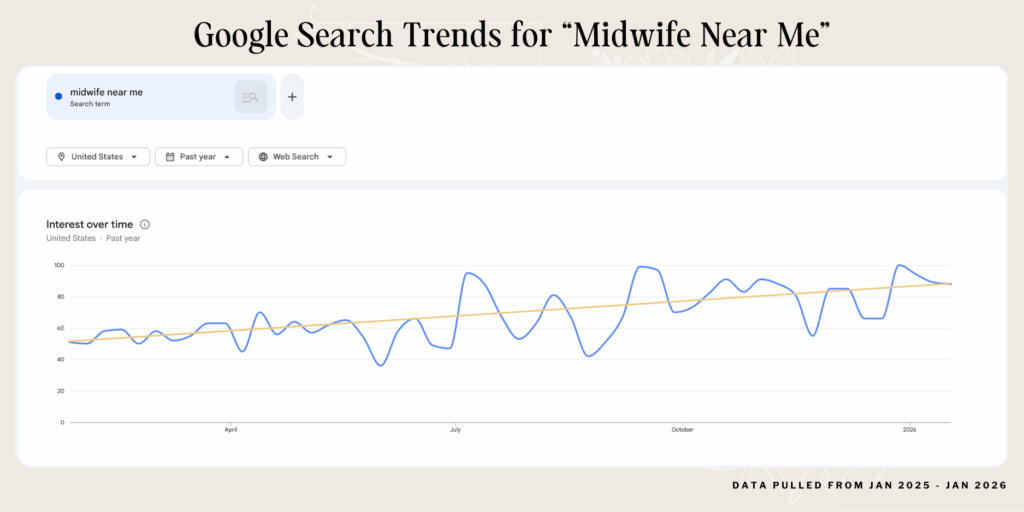
And that doesn’t include searches such as “home birth midwife near me” (~40 searches in the last month), “hospital midwife” (~100 searches in the last month), or “midwives near me” (~80 searches in the last month, and yes, this is a different search).
So, you tell me—do you think SEO is worth it?
To be honest, even with the data, it’s a personal decision and SEO works best when you know your expertise and the best fit expectant mother and family for YOU.
Either way, you can start implementing SEO for your midwifery business with just a few simple tips…
How to Start Using SEO: 5 Quick Start SEO Tips for Midwives
I’d loveee to sit here and tell you that there’s only a few things to do to get started with SEO and you’ll start showing up on Google. Unfortunately, you’ll need a bit more items for your to-do list to take the no. 1 spot…but, there’s plenty you can do now to start working towards it!!
If you’re ready to start using SEO or finally dig in to the SEO work you’ve been DIY-ing until now, here’s how to start:
#1. Start With Your Keywords and Go From There
This applies to all industries—not just midwifery. But you start with your keywords and go from there!
The right keywords put you in the right places—and ranking top 10 for “midwife in [your area here]” will mean way more for your SEO (and conversions) than ranking no. 1 for something off-the-wall and vaguely related to your business.
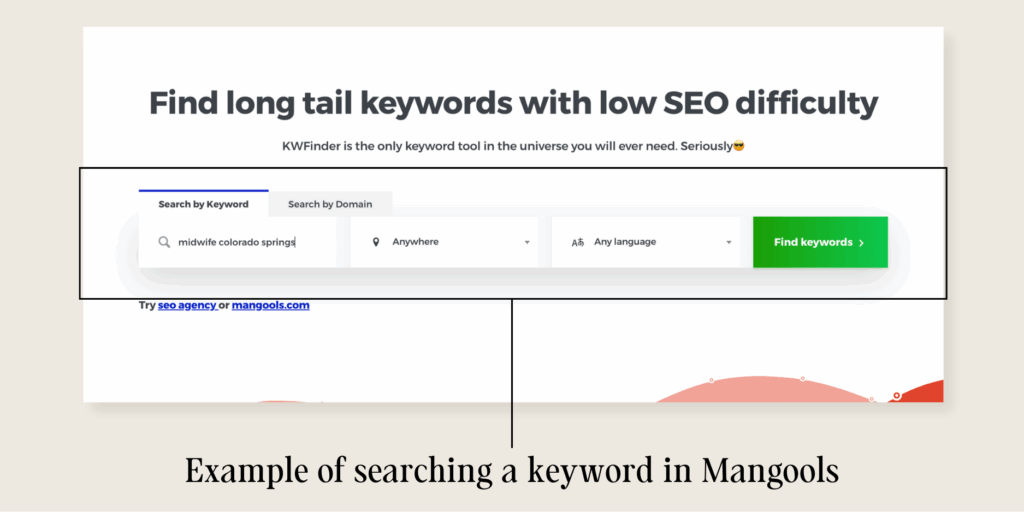
Use a keyword tool (my personal favorite is Mangools, they offer 5 searches a day with their free account) to find the right keywords for your core pages. Think keywords for your Home, About, Services, and Contact.
Your keywords should be transactional/actionable (not “how-tos,” save those for your blog posts!!). Aim for a similar set-up to “midwife services [your area]” or “midwifery [your area]” and similar variations.
If you want to find the right keywords on your first try, I highly recommend snagging Search Party! The Mini-Course for keyword research. It’s simple, straightforward, and will tell you exactly how to find the keywords you’re searching for!!
Pro tip: Don’t use “midwife near me” as your keyword!! Google (and other search engines) will do that part for you—use your location and the locations you serve, that’s how you’ll show up for those golden ‘near me’ searches.
#2. Add Your Metadata (and Use Your New Keywords)
You know what a hook is for a reel and it’s all over social media to help you catch the attention of your audience—your SEO metadata is the Google version of your hook, and the perfect place to use your keywords to rank higher in search results.

Your SEO page title is the bigger text that shows up in Google Search, you’ll want to keep it 60 characters or less—otherwise search engines will clip it and it won’t be seen anyways. As a midwife, you’ll want to make sure to include your location in your page titles!
Next is your meta description. This is like the “hook” of your webpage when it comes to SEO. You have a viewable limit of 160 characters—but if you go slightly over don’t stress it (I promise it’s not the end of the world).
Both should include your keyword, although you can include a VERY close variation in your meta description if it just doesn’t make sense naturally for your original keyword.
And we need to keep things natural. We don’t want to keyword stuff! This hurts your rankings (although black hat SEO strategists would try to convince you otherwise).
#3. Set Up (or Optimize) Your Google Business Profile
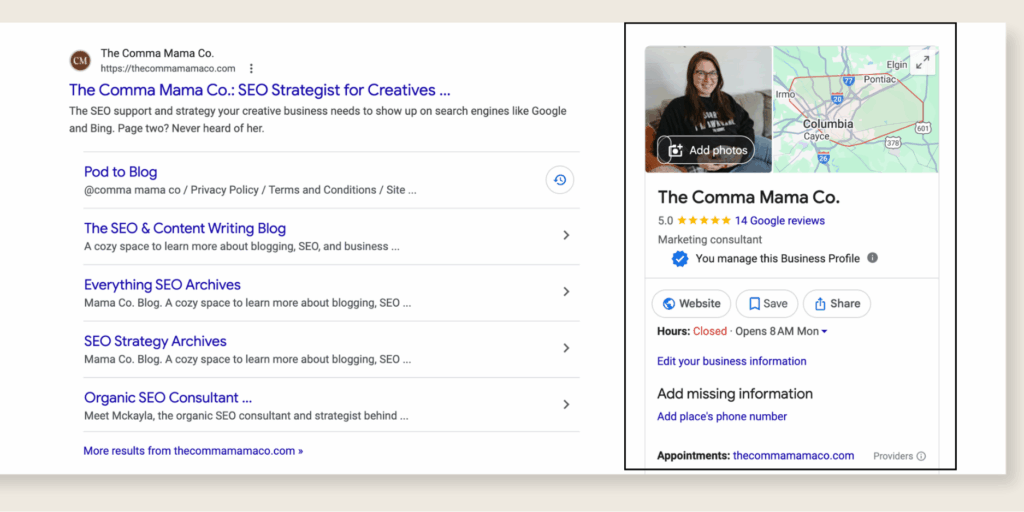
A Google Business Profile is a directory listing by Google—and it’s your key to showing up on Google Maps and making the most of local SEO. And local searches lead to conversions 80% of the time (yay us!!).
Even if you don’t have a midwifery practice or birth center location, you can (and should) still have a business profile listing your service area—or main service area.
Optimize your profile by using the same keywords you picked from step number one and on your website. You’ll use these in your GBP description, services, and products (if you have any). This consistency will also help your website rank higher in regular search results!!
Next step for your profile: get reviews!
Direct your clients to leave reviews to improve your rankings! When someone has a positive experience with you, Google wants to recommend you more (because when people on Google find what they need, they trust Google more, too).
#4. Focus on Your Website’s User Experience
This one is kind of broad as more things fall under ‘user experience’ than you would think—but even the simplest site with the right keyword and good user experience can outrank a midwifery site that spent $20k to look good.
There’s two main pieces of your user experience that I want you to focus on to improve your SEO:
- The technical (and legal): Make sure your website is easy to navigate. Your visitors shouldn’t have to dig around to find your services or to learn more about you—and you should 100% have your legal pages and disclaimers. A good place to start is adding the most important links to your header and any a parent might want to find in the footer!
- The on-page: This is your copy and design—your copy should answer the most important things pretty immediately, like who you are, what you do, and who you do it for. Your design should be accessible, avoid lots of moving elements or clustered text.
There’s soooo much to consider when it comes to user experience, but that’s a good place to start!
#5. Create a Dedicated Sales Page for Each Service
Sure, this seems extra—but a good way to think about this is considering why and when your clients are searching in the first place.
For example, if someone is considering a home birth and is in search of a midwife, then they’re likely searching for “home birth midwife” where a parent who is leaning more towards a hospital birth would search “hospital birth midwife.”
It could also be based on location if you travel to multiple areas (although I recommend researching keywords to see if people are actually searching in these areas).
For example, someone living in Colorado Springs would search “midwife colorado springs” or “colorado springs midwife” vs. a parent in Denver searching “midwife denver.”
Each service page is another opportunity to meet your ideal client—but don’t go too crazy! Start small and see how it works, each page needs its own content so search engines don’t consider it a duplicate which can add more work than expected to your plate!
BONUS!! Only Use One H1 Title Tag Per Page
This is a pretty important note to make, but make sure you’re only using ONE H1 tag per page. This can be a pain in the butt depending what website builder you’re using (like Squarespace, which defaults the style of your copy with the title/header tag you choose).
Your H1 is the main purpose/summary of the page and should include your keyword—but if you have multiple H1s, search engines get confused on which one is the most important…Even if it seems obvious to us!
You can use an H1 checker like this one to see how many H1s are on your page and what they are!
Do You Need to Start a Blog to Improve Your SEO? Short Answer: No.

Longer answer: it depends.
Starting a blog (or blogging) the RIGHT way can 100% improve your rankings on search engines and can actually diversify the audience you gain organically.
For example, with blogging, you can create content that reaches parents who have just started trying to get pregnant (or even just started thinking about it) AND reach moms who are having their fourth, fifth, or sixth little one.
That being said, blogging is not a requirement to do well. Search is everywhere, and there are multiple ways to do ‘well’ and get seen.
Outside of blogging, you can also build backlinks by being a guest on podcasts or joining directories. You can build authority by having a successful Substack or getting referral traffic from platforms like Instagram and Pinterest.
It takes longer, but if that fits your energy more and you have to DIY at this point in your business, then do those instead!
And when you are able to outsource, don’t forget to come back and find me—blogging for SEO is my specialty and I love supporting parenting and birth professionals!!
Ready to Get Your Midwifery Business to Show Up in Search?
Here’s what I know to be true: SEO works. It’s working for the midwives I’ve supported, and it can work for you too.
But it only works if you actually implement it. And that’s the hard part, right? Between late-night births, prenatal visits, postpartum check-ins, and trying to have a life outside of work—when exactly are you supposed to optimize your website?
That’s the beauty of starting small. Pick ONE thing from this guide and do it this week. Just one. Maybe it’s setting up your Google Business Profile. Maybe it’s adding metadata to your homepage. Maybe it’s finally creating that separate service page for home births.
One step, then another, then another. That’s how you build an SEO system that brings parents to you (instead of waiting to find them!).
And if you want someone to just handle all of this for you while you focus on the births and families that matter? That’s literally what I do (hi!! I’m Mckayla, an organic SEO consultant and strategist).
Not sure what you need? Check out my SEO Audit and Optimization services here!
Love this Post? Save it for Later:
Reader Etiquette
© - Content and images in this blog are copyright this blog unless stated otherwise. Feel free to repost or share images for non-commercial purpose, but please make sure to link back to this website and its original post.
℗ - We do not store any information about your visit to our website other than for analytics and optimization for content and reading experience through the use of cookies.
c/o - Our site does at times contain paid advertisements, sponsored content, and/or affiliate links.
You might want to check these out too while you're at it


categories
blogging
SEO
business

It's me, hi! Your SEO bestie.
get to know me
work with us
//
services
//
case studies
//
Mom of three, lover of all things blogging, and borderline obsessive coffee drinker — I also just happen to love making complicated things simple and accessible, especially when it comes to SEO. The blog is a collection of what I've learned from years of testing, trial and error, and working with amazing clients with impactful businesses (just like yours). Blogging and SEO doesn't have to be boring — and it definitely doesn't need to be difficult.
Mckayla
get your checklist
Want to improve your website SEO in one afternoon? This free resource offers 6 actionable steps you can take in 15 minutes or less to instantly improve your SEO.


