One of the industries I absolutely love working with — partially because it’s what I’ve known all my life, and partially because of the SEO opportunities — is bookkeeping and accounting. An industry that has the flexibility of working from home (or wherever they’d like) but also has the balance of opening their own local firm, or working with clients close to home.
It’s also an industry that thrives on niches, on knowing the specifics for an industry and sharing those insights with their clients to deliver a better service (and better client experience) and creating a long-term relationship.
But it’s also a must to recognize that there’s a lot of competition when it comes to marketing your bookkeeping or accounting services. With a lower barrier to entry — and with the ease of access when it comes to creating a website or marketing your offers that often mirror your competitors, finding clients becomes the hard part.
As an SEO expert who’s worked across multiple industries (and with many bookkeepers, accountants, and CFOs — who have booked $100K+ in annual contracts thanks to SEO), SEO might just be the channel to drive traffic, reach new clients, and sustain your business.
Let’s get into it →
What is SEO (And How is it Different for Bookkeepers & Accountants)?
SEO, also known as search engine optimization, is the system you set up to get your website on Google and other search engines or AI platforms (GEO/AIEO is, at its core, SEO).
And while its foundation is centered on your website, SEO is everywhere. It’s in the podcast episodes you’re a guest on, the newsletters you send to your list, your Instagram and Threads bios — and, if you’re local, your Google Business Profile (or Bing Places for Business).
SEO isn’t limited to Google or based solely on what Google requests for you to rank. It’s a (albeit, very strategic) compilation of recommendations and requirements from multiple search platforms like Bing, Yahoo, Brave, DuckDuckGo, ChatGPT, Claude, Perplexity…you get the picture.
SEO is a system vs. a set task. There’s so much that contributes to how you rank, where you rank, and what you rank for — and each aspect plays a role in the other, each portion of your strategy and implementation impacting and effecting the other.
It’s equally overwhelming by how much there is to do and simplified by how small of a task you need to complete to “move the needle.” And for bookkeepers and accountants, it’s a balance of speaking to your audience where they’re at and anticipating the questions they have before, based on WHO they are and what they want.
How to Improve Your SEO as a Bookkeeper or Accountant
There are a million things you could do to improve your SEO, but that would take, well, forever. And not everything is a requirement, meaning while your foundationals should be taken care of, there’s so much more you can choose to do or not.
SEO also benefits from consistency, so finding a workflow that works for you (or outsourcing to someone who has a good workflow, like us) is more impactful than doing something new 24/7.
With that in mind, here are some of the SEO tips bookkeepers and accountants (like you) can use to improve their SEO and reach new clients:
#1. Optimize Your Website’s Core Pages
Whether you have a 1-page website or 10-page website, optimizing your core pages (usually your Home, About, Bookkeeping Services, and Contact) is a must. This is where search engines are pulling the most context for what you do (bookkeeping or accounting), who you do it for (your ideal client), and where you do it (virtually, locally, or a mix of both).
You can start by researching a keyword — my personal favorite tool to use is Mangools — to use for your Home page (a keyword is the main phrase someone might use to “Google” what you do, for example, think “bookkeeper for website designers” or “accountant for s-corps”).
You’ll use this keyword throughout your page and copy, but START with your SEO page title and meta description:

If you’re looking for more information (or how-tos) on creating these, now is a really good time to download the SEO Checklist — it’s free, and perfect for getting started with DIY-ing your SEO!
#2. Pick a Niche, Industry, or Offer
I’m not saying you can’t branch out in the future or can’t work with anyone else, but if you can niche down your offer to a specific niche, industry, or type, your SEO opportunities literally expand to limitlessness (or near limitlessness).
For example, becoming a bookkeeper that works specifically with coaches or coaches and services providers vs. one that works with “small businesses.” Or an accountant that works primarily with local businesses in Florida (or wherever you’re located) vs one that works with “united states.” Or a bookkeeper who only does clean-ups, set-ups, or only works with Quickbooks or Xero.
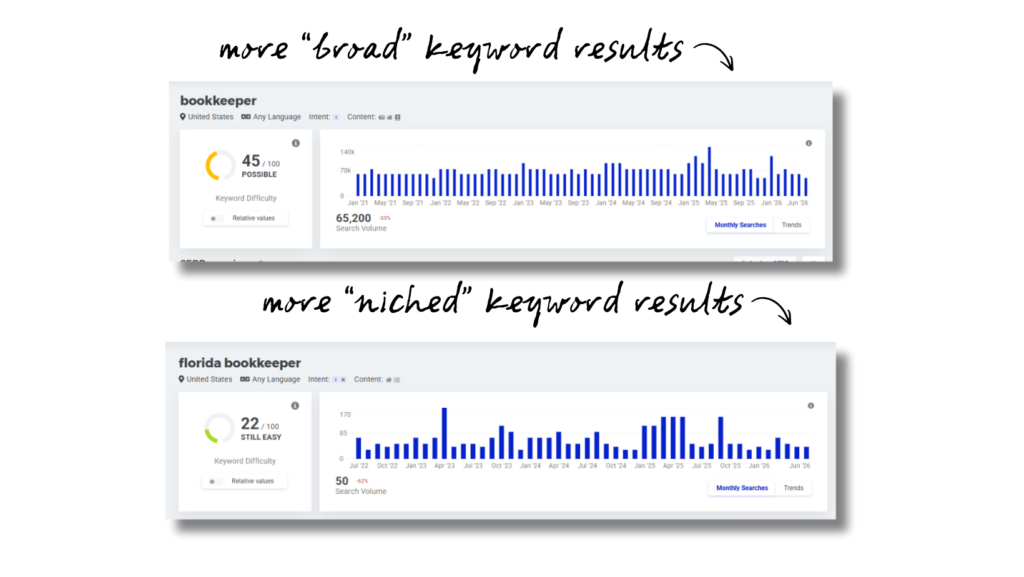
This works because the keyword opportunities (how easy it is to rank for a search term or keyword, the thing people are searching to find you) for niched keywords are less competitive in comparison to broad keywords.
AKA it’s easier for you to actually rank for and get traffic to your website from (vs targeting something wayyy too broad and difficult and forever being buried under websites like Collective, QuickBooks, or Pilot) — take this into consideration when doing tip #1, it’ll help, I promise 😉.
#3. Choose ONE Way to Work on Your SEO
Remember how I said there’s like, a million ways to improve your SEO? There is, but you need to start with ONE way (it’s like how marketers recommend starting with one platform). You have two methods:
- On-site SEO — making improvements to your own website such as adding more service pages, location pages, blogging, or improving your copy and/or user experience. Essentially, your goal here is to increase the time spent on and discoverability of your website.
- Off-page SEO — borrowing the reputation and traffic of outside platforms (like social media) to send more traffic to your website and build your “reputation” or “authority” with search engines to get your core pages to rank better, usually through podcast guesting, guest blogging, joining directories, etc.
Eventually, you’ll want a combination of the two — a good method of improving your on-site SEO and one for improving your off-page SEO. But starting with one prevents you from getting overwhelmed and wanting to quit SEO altogether (which has happened more times than I can count).
And if you’re reading this and have already determined that SEO sounds great, but you don’t need another thing on your already-full to-do list, let me take it off your plate and do it for you – it’s what my signature organic SEO services are for, anyways 💚
As for Your Local SEO…
Even if you’re not technically restricting your services to only one location (for example, even though you’re based in Florida, and work in Florida, you serve clients in Florida and beyond), you still want to work on your local SEO.
Your local SEO as a bookkeeper or accountant should focus on your “home base,” and create a Google Business Profile – which you should then migrate into Bing Places for Business. Both are considered local directories, but offer amazing SEO benefits.
Plus, it provides a trusted source for clients to leave reviews, which in turn improves your website’s SEO.
If You Only Do One Thing to Improve Your SEO Today, Do This:
Pick one page and see what you can do. Usually this is a good “tester” for if SEO is something you want to do or if it feels like you’re pulling teeth and never want to touch it again. From there, you can determine if you just need some done-with-you help (like what we offer in Back Pocket SEO) or if you want to hand it off (like our done-for-you SEO services).
Every little thing — even if it’s just one page — can help your SEO and how (or if) you show up in Google, Bing, or AI.
And if you’re looking for an easy way to get started, download the SEO Checklist — it’s free, and every task can be done in 15 minutes or less 💃